More Recipes
Like with Tadashi’s Perfect Steamed Rice on page 60, here we share, basically, Tadashi’s perfect Japanese-style fried rice. You can’t go wrong with this method. This dish, also known as chahan, uses leftover rice and cooks hot—and fast. Watch a few wok-cooking videos on YouTube to get hyped up! Woks are great, but a cast-iron, carbon steel, or quality nonstick skillet works fine too. (We used Harris’s trusty 11-inch cast-iron Lodge skillet to cook this dish.) Okay, so you might be wondering: What’s the difference between Japanese fried rice and its famous Chinese cousin—the global fried-rice standard? The Japanese variety uses less soy sauce, resulting in a lighter color and milder flavor, and relies on Japanese short-grain rice as well as local ingredients like shiitake and kakuni (lots of other ingredients work too; see the list on page 77). But ultimately, this dish is, in fact, an adaptation of Chinese fried rice, which was introduced to Japan in the 1860s by Chinese immigrants and evolved from there. Some practical considerations: If you don’t happen to own a chuan (a special Chinese wok spatula), use a big ol’ cooking spoon to turn the rice; you’ll be stirring throughout the cooking. Make sure to ventilate, because it could get smoky. And remember, hayai—move quickly!
INGREDIENTS
2 tablespoons toasted sesame oil
3 eggs, beaten
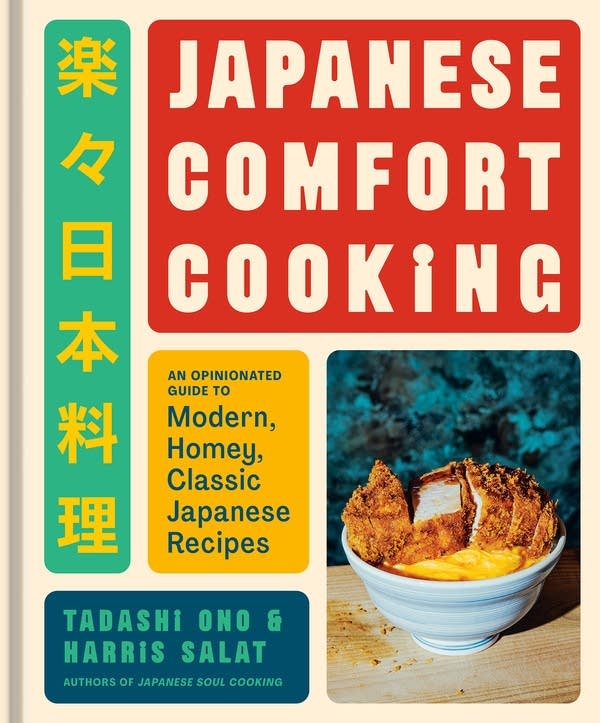 Japanese Comfort Cooking
Tadashi Ono and Harris Salat
Japanese Comfort Cooking
Tadashi Ono and Harris Salat
2 cups cooked Japanese short- grain white rice, warm (leftover rice is fine; microwave it if cold)
1 tablespoon sake
1 tablespoon soy sauce
Pinch of salt
¼ teaspoon ground white pepper
¼ cup chopped scallions, plus 2 tablespoons for garnish
1 tablespoon toasted sesame seeds
DIRECTIONS
Preheat a large skillet (cast-iron or stainless steel is ideal) over medium-high heat. You want the skillet really hot. (If using stainless steel, test by dripping a few drops of water onto the surface of the skillet. If the water beads then vaporizes—instead of just sizzling—the skillet is ready.)
Add the sesame oil. It will immediately start to smoke. Coat the surface with the oil, then quickly add the eggs. The eggs will immediately begin to bubble rapidly. Cook for about 10 seconds, then dump the rice over the eggs. The eggs will still be uncooked on top—that’s fine. Now, use your cooking spoon to mix the egg and rice together and break up any clumps. This action will coat the rice with uncooked egg, which will prevent the grains from sticking to each other— you don’t want clumpy fried rice. Stir constantly for about 30 seconds. Add the sake, soy sauce, salt, and white pepper. Keep stirring. Add the scallions. Stir for about 11⁄2 minutes more and remove from the heat.
Divide the rice among four bowls, garnish with the additional scallions and the sesame seeds, and serve immediately.
“Reprinted with permission from Japanese Comfort Cooking: An Opinionated Guide to Modern, Homey, Classic Japanese Recipes by Tadashi Ono and Harris Salat, copyright © 2026. Published by Ten Speed Press, an imprint of Penguin Random House.”
When you shop using our links, we earn a small commission. It’s a great way to support public media at no extra cost to you
Before you go...
Each week, The Splendid Table brings you stories that expand your world view, inspire you to try something new, and show how food connects us all. We rely on your generous support. For as little as $5 a month, you can have a lasting impact on The Splendid Table. And, when you donate, you’ll join a community of like-minded individuals who love good food, good conversation, and kitchen companionship. Show your love for The Splendid Table with a gift today.
Thank you for your support.
Donate today for as little as $5.00 a month. Your gift only takes a few minutes and has a lasting impact on The Splendid Table and you'll be welcomed into The Splendid Table Co-op.