The following recipe is a Sichuan classic and one of my personal favorites. More than any other dish, for me it sums up the luxuriant pleasures of Sichuan eating: the warmth of its colors and tastes, the rich subtlety of its complex flavors.
Like other fish-fragrant dishes, it is prepared with the flavorings used in traditional Sichuanese fish cooking: pickled chiles, garlic, ginger, and scallion. But unlike the more illustrious fish-fragrant pork slivers, this dish derives its color not from pickled chiles alone, but from pickled chiles mixed with fava beans in the famous Pixian chili bean paste.
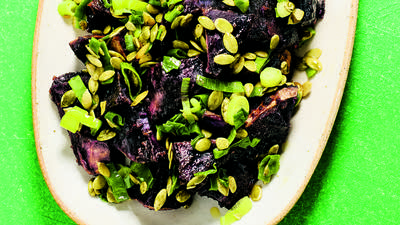
The sauce is sweet and sour and spicy, with a reddish hue and a visible scattering of chopped ginger, garlic, and scallion. The dish is equally delicious hot or cold. I usually serve it to guests with a meat or bean curd dish and a stir-fried green vegetable, but it makes a fine lunch simply with brown rice and a salad. The eggplants, deep-fried to a buttery tenderness, are delectable. I have eaten this dish in restaurants all over Sichuan and recorded numerous different versions of the recipe. The following will, I hope, make you sigh with delight.
Ingredients
1 1/3 - 1 2/3 pounds eggplants (2 decent-sized eggplants or a generous handful of slender Asian eggplants)
Salt
Peanut or corn oil for deep-frying
1 1/2 tablespoons Sichuanese chili bean paste
3 teaspoons finely chopped fresh ginger
3 teaspoons finely chopped garlic
1/2 cup chicken stock
1 1/2 teaspoons white sugar
1/2 teaspoon light soy sauce
1 1/3 teaspoons cornstarch mixed with 1 tablespoon cold water
1 1/2 teaspoons Chinkiang or Chinese black vinegar
4 scallions, green parts only, sliced into fine rings
1 teaspoon sesame oil
Instructions
1. Cut the eggplants in half lengthwise and then crosswise. Chop each quarter lengthwise into 3 or 4 evenly sliced chunks. Sprinkle with 1 1/2 teaspoons of salt and leave for at least 30 minutes to draw out some of the juices. If you are using Asian eggplants, simply slice them in half lengthwise and then into 3-inch sections—there is no need to salt them.
2. In your wok, heat oil for deep-frying to 350-400°F (at this temperature it will just be beginning to smoke). Add the eggplants in batches and deep-fry for 3-4 minutes until slightly golden on the outside and soft and buttery within. Remove and drain on paper towels.
3. Drain off the deep-frying oil, rinse the wok if necessary, and then return it to a high flame with 2-3 tablespoons of oil. Add the chili bean paste and stir-fry for about 20 seconds until the oil is red and fragrant; then add the ginger and garlic and continue to stir-fry for another 20-30 seconds until they are fragrant. Take care not to burn the flavorings—remove the wok from the heat for a few seconds or turn down the heat if necessary.
4. Add the stock, sugar, and soy sauce and mix well. Season with salt to taste if necessary.
5. Add the fried eggplants to the sauce and let them simmer gently for a few minutes to absorb some of the flavors. Then sprinkle the cornstarch mixture over the eggplants and stir in gently to thicken the sauce. Next, stir in the vinegar and scallions and leave for a few seconds until the onions have lost their rawness. Finally, remove the pan from the heat, stir in the sesame oil, and serve.
Adapted from Land of Plenty: A Treasury of Authentic Sichuan Cooking. Copyright 2003 by Fuchsia Dunlop. Published by W. W. Norton & Company.
Before you go...
Each week, The Splendid Table brings you stories that expand your world view, inspire you to try something new, and show how food connects us all. We rely on your generous support. For as little as $5 a month, you can have a lasting impact on The Splendid Table. And, when you donate, you’ll join a community of like-minded individuals who love good food, good conversation, and kitchen companionship. Show your love for The Splendid Table with a gift today.
Thank you for your support.
Donate today for as little as $5.00 a month. Your gift only takes a few minutes and has a lasting impact on The Splendid Table and you'll be welcomed into The Splendid Table Co-op.